 Skip to content
Parents are well known for sneaking into their children’s rooms to see if they are breathing. When baby starts trying to sleep on his stomach, you can bet your heart will skip a beat.
Is Stomach Sleeping Common?
Many Americans today may have been raised lying on their stomachs. Parents find that babies like to sleep better on their stomachs—there’s something about stomach sleeping that calms the nervous system.
Lying face down used to be normal
One of the most challenging aspects of parenting is that health guidelines are also constantly changing. As recently as the 1990’s 70% of babies were delivered from pregnancy. It wasn’t until 1992 that the American Academy of Pediatrics officially recommended that parents sleep babies in the back for the first year of their lives.
You may have heard of the “Back To Sleep” campaign, which was a public campaign to put babies to sleep on their backs, following current medical advice.
Risk of SIDS
Research has shown a link between a baby’s sleep pattern and the risk of SIDS. Doctors do not understand or know what causes SIDS, which is why it has been given the obscure name “Sudden Infant Death Syndrome”.
SIDS syndrome
The incidence rate of SIDS is about 0.05% or one death out of every 2000 babies, according to the National Centers for Health Statistics. So even though it is a rare occurrence it is still a cause of death.
When a baby sleeps on their stomach, there is a possibility that their head may be pressed into the mattress. This can cause an air pocket to form around their face. This causes a decrease in the ability to breathe and breathe – it’s definitely not a good place.
Sleep Well
However, SIDS rates fell by half when parents started sleeping on their backs. Parents are also advised not to put loose items in the crib to reduce the risk of SIDS. Bathing helps.
Obviously, no parent wants to put their child at risk. Hospitals often carry newborn babies and encourage parents to continue to do so for better sleep, but it is not safe to carry a baby in the womb.
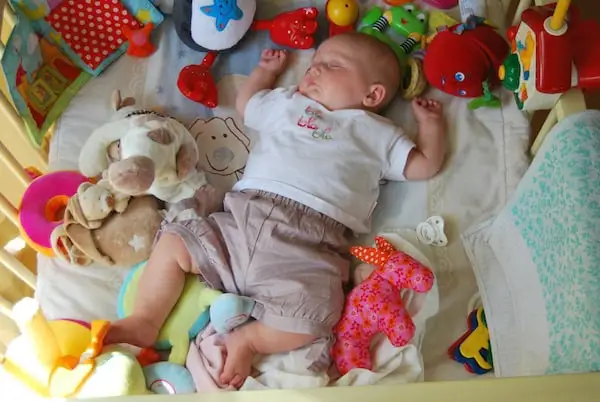
Why Do Parents Put Babies to Sleep on the Floor?
A recent BabyCenter.com survey found that out of 24,000 parents, almost as many parents put their babies to sleep on their stomachs as on their backs. This is despite the fact that half of the parents admitted that they were afraid of SIDS.
Although sometimes there may be a lack of awareness, some parents still choose it, perhaps because the children can do it themselves, and / or this helps the whole family to sleep better. If your baby sleeps on his stomach, you are not alone.
When Can My Baby Sleep?
The risk of SIDS is greatest if the baby is younger than four months, although it can be a different factor for babies under one year. One of the biggest issues is that a baby does not have the ability to roll over when it is born.
Old is good
There is no hard and fast rule to this question. A baby’s highest risk of SIDS is between 1-4 months, so you can say that after that time it starts slowly. But the problem is that all children are different and this has nothing to do with age and more to do with their development.
For premature babies there is another reason to be cautious. For all time, healthy babies, it’s still important to see if your baby has regained strength in the throat.
You want to see that the child has the ability to roll over on his own. When babies are able to roll over successfully, babies often roll over on their own to lie on their stomachs. The idea is that if for some reason the child can’t breathe, they can roll over.
If you don’t see neck strength or rolling, the back is fine. Even if you see these things are there, you want to test your child and the situation.

There is one caveat
A study conducted at St. Louis Children’s Hospital found that babies who were previously sleeping on their stomachs can adapt better. This may seem like a cycle, apparently a baby who sleeps well in the womb is more likely to repeat it.
Babies who sleep on their stomachs also breathe in some of the bad air they exhaled. However, babies learn to lift their heads to the side to get fresh air.
The takeaway, however, is that parents may think a child is ready when they can hold their head up, even though that may not be the case. If the baby is suddenly placed on the stomach to sleep, there is reason to persist.
Security Measures


A inflatable mattress can be a warning that is worth taking. A friend in our community who needs special help agreed with that, and said that she and her husband had tried it, putting their faces in it to see if it was really breathable. They thought about it when their child rolled only from back to front, but not from front to back.


Baby monitors are a way to keep an eye on your child, preferably from another room.
Listen to Your Child and His Development Directly
Possible steps
Watch your baby sleeping, especially if he is on his stomach, and see if your baby can move his head to the side or not. If the babies face down, pressed into the mattress then it is very difficult.
Some baby monitors can also monitor breathing, so for the worried parent (and there are a lot of us out there), that can do the trick.
Rolling is important
Make sure your child has good range of motion and strength in their neck. This can be recommended at the beginning of pregnancy, which doctors recommend from two months.
It’s always better to be safe than sorry. When your baby is very young, following the doctor’s advice to put him to sleep on his back will give you peace of mind, even if the handover may not allow you to sleep easily. Once they are big enough to roll over, there is usually nothing to stop them from ending up on the stomach.
The end
Children may be different but the bottom line is that development is a personal thing. Parents should know that by following medical advice for sleeping up to one year, you can reduce the risk of SIDS.

Sharing is caring!