 Skip to content
Quick Answer
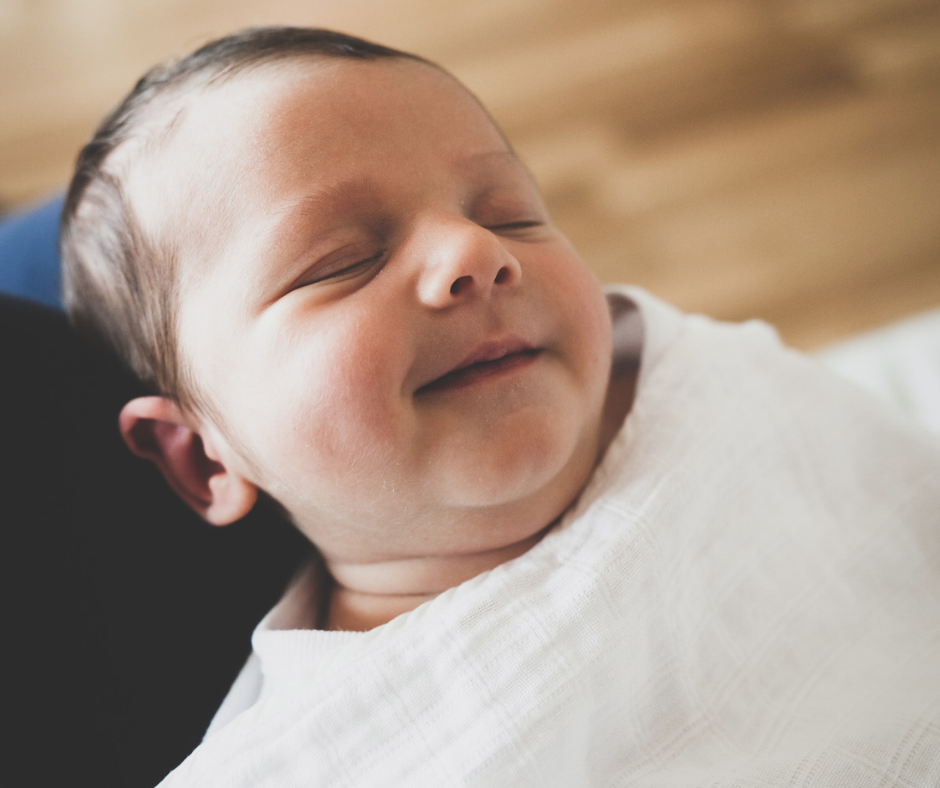
Few moments are as memorable for new parents as seeing their baby smile for the first time. Even in the earliest days of life, newborns may make facial expressions that resemble smiles, sometimes while sleeping or drifting between sleep and wakefulness.
However, the first intentional social smiles generally emerge later, often around six to eight weeks of age, although timing varies from baby to baby. A social smile is different from an early spontaneous smile because it occurs in response to social interaction, such as seeing a familiar face or hearing a caregiver’s voice.
For Newborn Care Specialists, understanding the development of smiling can help families appreciate these early expressions without placing unnecessary pressure on babies to reach milestones at a specific moment.
Key Takeaways
- Newborns may display smile-like expressions shortly after birth.
- Early smiles are often spontaneous and may occur during active sleep.
- Social smiles generally emerge during the first two months of life.
- Social smiling reflects developing social attention and communication.
- Familiar voices, faces, and gentle interaction can encourage opportunities for social engagement.
- Babies develop at different rates, and individual variation is expected.
- A newborn doesn’t need to smile to demonstrate comfort or connection.
- Responsive caregiving supports early social and emotional development.
- Developmental milestones should be interpreted using appropriate age expectations.
- Newborn Care Specialists can help parents understand and celebrate developmental progress without creating unnecessary worry.
Why Newborn Smiles Are So Special
A baby’s first smile can be an unforgettable moment.
For parents who have spent weeks adjusting to feeding schedules, interrupted sleep, and the many responsibilities of caring for a newborn, a smile can feel like a beautiful reward.
It’s often one of the first visible signs that a baby is beginning to participate in social interaction.
But smiling doesn’t suddenly appear out of nowhere.
The facial muscles, nervous system, sensory systems, and developing social abilities involved in smiling begin maturing long before a baby produces a recognizable social smile.
Understanding this process makes the milestone even more remarkable.
Do Newborns Really Smile?
Yes.
Newborns can make facial expressions that look like smiles, sometimes within the first days of life.
These early expressions may occur during sleep, drowsiness, or quiet periods.
However, not every newborn smile represents the same developmental process.
Researchers distinguish between spontaneous smiles and social smiles.
Spontaneous smiles can occur without an obvious social trigger.
Social smiles, on the other hand, are associated with interaction and become more apparent as babies develop.
The difference is important because parents may assume that every smile means their baby is intentionally responding to them.
While those early expressions are certainly enjoyable, intentional social communication develops gradually.
Why Do Newborns Smile in Their Sleep?
One of the most common times parents notice a newborn smiling is during sleep.
A baby may appear completely relaxed, then briefly curl the corners of their mouth into a smile.
Sometimes this happens alongside other facial movements, twitches, or changes in expression.
Newborn sleep includes active sleep, a state associated with rapid eye movements, irregular breathing patterns, and spontaneous body movements.
Facial expressions, including smile-like movements, may occur during this state.
These expressions do not necessarily mean that the baby is dreaming about something pleasant.
We cannot determine the content of a newborn’s dreams based on facial movements.
Instead, sleep smiles are generally understood as part of early spontaneous facial activity.
What Is a Social Smile?
A social smile is a smile that occurs in response to another person or a social interaction.
For example, a baby may look toward a caregiver’s face and smile when the caregiver speaks or smiles.
This differs from a spontaneous smile that occurs without an identifiable social trigger.
Social smiling reflects the developing ability to attend to people and participate in early communication.
It is an important milestone in social and emotional development.
However, social smiles don’t appear in a perfectly predictable pattern.
A baby may smile socially one day and show little interest in smiling the next.
Fatigue, hunger, alertness, and individual temperament all influence how a baby responds.
When Do Babies Start Smiling Socially?
Social smiling often begins to emerge around six to eight weeks of age.
The Centers for Disease Control and Prevention includes smiling when spoken to or smiled at among the developmental milestones that most babies demonstrate by two months.
It’s important to understand how developmental milestones are used.
They are intended to help parents and healthcare professionals monitor development, not to create a competition between babies.
Some infants may demonstrate social smiles earlier, while others may develop them later.
For babies born prematurely, developmental expectations may need to be interpreted using corrected age.
Parents should discuss concerns about social development with their pediatrician rather than relying on comparisons with other babies.
How Does a Baby Learn to Smile at People?
Social smiling develops through the interaction of several systems.
A baby must become increasingly able to:
- Attend to visual or auditory information
- Recognize socially relevant stimuli
- Coordinate facial muscle activity
- Respond during periods of alertness
- Participate in emerging social exchanges
These abilities don’t mature all at once.
During the newborn period, babies gradually become more attentive to faces and voices.
As their visual attention and neurological control develop, they become increasingly capable of producing smiles in response to interaction.
Social smiling is therefore part of a much broader developmental process.
Why Faces Matter So Much
Human faces are particularly important sources of social information.
Even newborns demonstrate certain preferences for face-like visual patterns.
As babies mature, they become increasingly attentive to caregivers’ faces.
A caregiver’s face provides information through expression, movement, and the coordination of facial gestures with speech.
When a parent smiles, speaks gently, or changes their expression, the baby experiences a combination of visual and auditory input.
These experiences contribute to early social development.
However, newborns have limited attention spans.
A baby may briefly look toward a face and then look away.
That is not necessarily a sign of disinterest.
It may simply reflect the baby’s developing capacity for attention.
Can Parents Encourage Their Baby to Smile?
Parents cannot force a baby to reach a developmental milestone before they’re ready.
But they can create comfortable opportunities for social interaction.
For example, a parent might hold the baby at a comfortable distance during a quiet alert period, smile gently, and speak in a warm voice.
They can pause and allow the baby time to respond.
Sometimes the baby may look toward the parent’s face.
Sometimes they may move their arms or change their expression.
And eventually, a social smile may appear.
The important part is the interaction itself, not whether the baby produces a particular response.
Why Responsive Interaction Matters More Than Getting a Smile
It’s natural for parents to want to see their baby smile.
But social development involves much more than smiling.
A newborn communicates through changes in attention, body movement, facial expressions, sounds, and behavioral states.
A baby who looks calmly toward a caregiver or settles during gentle interaction may be participating in an early social experience.
An NCS can help parents recognize these quieter moments.
Rather than encouraging parents to repeatedly stimulate the baby until they smile, the specialist can explain that social engagement develops gradually.
The goal is to create a safe, responsive environment where the baby can interact at their own pace.
What About Babies Who Rarely Smile?
Some babies are naturally more expressive than others.
Even after social smiling begins, the frequency of smiling can vary.
A baby may smile more during certain times of day or when feeling well-rested and comfortable.
Other babies may show social interest through looking, vocalizing, or other behaviors.
However, parents should discuss developmental concerns with their pediatrician.
If a baby is not demonstrating expected social milestones, has limited responsiveness to sounds or faces, or shows a loss of previously acquired abilities, professional evaluation is appropriate.
An NCS should avoid making assumptions about developmental conditions based on smiling frequency alone.
How Prematurity Can Affect Social Smile Timing
Babies born prematurely may reach developmental milestones according to a different timeline than babies born at term.
Healthcare professionals often use corrected age when evaluating early development in premature infants.
Corrected age accounts for the number of weeks a baby was born before the expected due date.
For example, a baby born eight weeks early may be assessed differently from a full-term baby of the same chronological age.
An NCS caring for a premature infant should follow the family’s individualized developmental guidance.
Milestone comparisons should be made thoughtfully and with appropriate medical context.
Can Babies Smile at People Other Than Their Parents?
Yes.
As social smiling develops, babies may respond to a variety of caregivers.
A familiar NCS, grandparent, sibling, or other person may eventually receive a smile.
This doesn’t diminish the importance of the parent-child relationship.
Babies can participate in positive interactions with multiple caregivers.
The quality and consistency of responsive care are important.
An NCS should celebrate these moments while also encouraging parents to enjoy their baby’s emerging social abilities.
How Newborn Care Specialists Can Support Early Social Development
Professional newborn care offers many opportunities to support social interaction.
Use Gentle Face-to-Face Interaction
During quiet alert periods, allow the baby opportunities to look toward the caregiver’s face.
Speak Naturally
A warm voice can provide auditory and social information.
Respond to the Baby’s Cues
If the baby looks away, becomes fussy, or appears tired, reduce stimulation.
Encourage Parent Participation
Help parents recognize the moments when their baby is most available for interaction.
Avoid Forcing Responses
Don’t repeatedly stimulate a baby in an attempt to produce a smile.
Celebrate Development Without Comparison
Remind families that milestones emerge gradually and individual variation is normal.
Why Parents Shouldn’t Compare Their Baby’s Smile Timeline
Parents are surrounded by developmental information.
Social media, parenting apps, and conversations with friends may create the impression that every baby should reach milestones at exactly the same age.
But development is not a race.
A baby who smiles socially at seven weeks isn’t necessarily more advanced than a baby who begins smiling later.
Milestones represent broad developmental patterns rather than measures of intelligence or future ability.
An NCS can help families focus on their baby’s overall development and individual progress.
When parents have concerns, the pediatrician is the appropriate resource for assessment.
What Does the Research Say?
Research on early facial expressions has documented spontaneous smiling during the newborn period.
Studies have also examined the emergence of social smiling and its relationship to developing social attention.
The CDC identifies smiling in response to speech or smiles as a milestone that most babies demonstrate by two months of age.
Research on early social development emphasizes that smiling is part of a broader system of communication involving attention, facial expression, vocalization, and responsive interaction.
These findings support the importance of allowing babies to develop social abilities naturally while providing opportunities for warm, responsive engagement.
Why Education Matters
Understanding the difference between spontaneous and social smiling helps Newborn Care Specialists provide accurate information to families.
It also prevents common misconceptions.
A smile during sleep doesn’t necessarily indicate a happy dream.
A baby who isn’t smiling socially at four weeks isn’t automatically behind.
And a baby who looks away during an interaction isn’t necessarily rejecting the caregiver.
Professional education helps caregivers interpret newborn behavior within the context of normal development.
It also reinforces the importance of supporting parents without creating unnecessary expectations.
Interested in Learning More About Newborn Development?
At Newborn Care Solutions®, our educational programs help Newborn Care Specialists, nannies, postpartum doulas, and other infant care professionals understand the science behind newborn behavior and development.
From early communication and social milestones to feeding, sleep, safety, and responsive caregiving, professional education helps caregivers provide knowledgeable support to families.
Whether you’re beginning your career or continuing your education, understanding newborn development can help you better appreciate the remarkable changes occurring during the first months of life.
Not sure which training path is right for you?
Take our free NCS Training Path Quiz:
References
- Centers for Disease Control and Prevention. Important Milestones: Your Baby By Two Months.
- Messinger, D., & Fogel, A. (2007). The Interactive Development of Social Smiling. Advances in Child Development and Behavior, 35, 327–366.
- Wolff, P. H. (1963). Observations on the Early Development of Smiling. In Determinants of Infant Behaviour II. Methuen.
- American Academy of Pediatrics. HealthyChildren.org. Infant Social and Emotional Development.
- Centers for Disease Control and Prevention. Learn the Signs. Act Early.
Final Thoughts
A baby’s first social smile is one of the most memorable milestones of early parenthood.
But the journey toward that smile begins long before it appears.
From spontaneous facial expressions during sleep to brief moments of attention and early social engagement, newborns are gradually developing the abilities that support communication and connection.
For parents and caregivers, the best approach is simple.
Talk to the baby.
Smile.
Enjoy quiet moments together.
Notice their cues.
And allow development to unfold naturally.
That first social smile may last only a second, but for the people who love that baby, it’s a moment they’ll remember for years.