 Skip to content
Quick Answer
Baby bottles, nipples, and other feeding equipment come into direct contact with milk and a newborn’s mouth. Proper cleaning is important because milk residue and moisture can allow microorganisms to remain on feeding surfaces and potentially multiply.
The Centers for Disease Control and Prevention (CDC) recommends thoroughly cleaning infant feeding items after every feeding. For babies younger than two months, babies born prematurely, or babies with weakened immune systems, daily sanitizing provides an additional layer of protection.
Cleaning and sanitizing are different processes. Cleaning removes milk residue and contaminants using soap, water, and appropriate scrubbing. Sanitizing further reduces microorganisms after cleaning.
For Newborn Care Specialists, understanding both processes—and maintaining a consistent system for drying and storing equipment—is an essential part of providing safe, professional newborn care.
Key Takeaways
- Infant feeding equipment should be cleaned after every use.
- Cleaning and sanitizing are not the same thing.
- Bottles should be completely disassembled before cleaning.
- Use a dedicated wash basin and bottle brush when handwashing feeding equipment.
- The CDC recommends daily sanitizing for infants younger than two months, infants born prematurely, and infants with weakened immune systems.
- Dishwasher cleaning with hot water and a heated drying or sanitizing cycle may also meet sanitizing needs.
- Allow equipment to air-dry completely before storage.
- Avoid drying bottle parts with a dish towel, which can transfer germs.
- Breast pump equipment requires its own appropriate cleaning procedures.
- A consistent system helps prevent contamination and mistakes during busy overnight shifts.
Why Bottle Hygiene Matters More for Newborns
Newborns are still developing immune defenses, and certain infections can be especially serious during early infancy.
Feeding equipment provides a potential route for exposure to microorganisms when it isn’t cleaned properly.
Milk residue can remain inside bottle nipples, around collars, or in small crevices that aren’t immediately visible.
If equipment is rinsed but not thoroughly washed, residue and microorganisms may remain.
For a healthy older infant, the risk profile may differ from that of a premature newborn or a baby with medical vulnerabilities.
That’s why public health recommendations place additional emphasis on sanitizing equipment used for the youngest and most medically vulnerable babies.
Cleaning vs. Sanitizing: What’s the Difference?
These terms are often used interchangeably, but they describe different processes.
Cleaning
Cleaning removes milk residue, dirt, and microorganisms from feeding equipment.
It generally involves soap, water, and mechanical action such as scrubbing.
Thorough cleaning is necessary after every use.
Sanitizing
Sanitizing is an additional step intended to further reduce microorganisms on equipment that has already been cleaned.
Depending on the equipment and manufacturer’s instructions, sanitizing methods may include boiling, steam, or appropriate dishwasher cycles.
Sanitizing doesn’t replace cleaning.
A bottle with dried milk residue shouldn’t simply be placed in a sanitizer without first being properly cleaned.
Step 1: Wash Your Hands Before Handling Feeding Equipment
Hand hygiene is the starting point for safe bottle preparation and cleaning.
Before handling bottles, nipples, or other feeding equipment, wash your hands thoroughly with soap and water.
The CDC recommends scrubbing hands for at least 20 seconds.
Hand hygiene is especially important after diaper changes, handling trash, using the bathroom, or touching potentially contaminated surfaces.
An NCS should also consider the cleanliness of the work area.
A sanitized bottle can become contaminated again if it is placed on an unclean countertop or handled with dirty hands.
Step 2: Completely Disassemble the Bottle
Before cleaning, separate the bottle into its individual components.
Depending on the bottle design, these may include:
- Bottle
- Nipple
- Collar or ring
- Cap
- Venting components
- Valves
- Seals
- Other removable parts
Some anti-colic bottles contain several small pieces.
These components require particular attention because milk can become trapped in narrow channels or crevices.
Follow the manufacturer’s instructions for disassembly and cleaning.
A bottle that appears clean from the outside may still contain residue inside a venting system.
Step 3: Rinse the Parts
Rinse bottle components under running water.
The CDC allows warm or cold water for the initial rinse.
The goal is to remove loose milk residue before washing.
Avoid placing dirty bottle parts directly into a kitchen sink where they may come into contact with germs from other household activities.
Step 4: Wash Thoroughly With Soap and Water
When washing by hand, the CDC recommends using a clean basin reserved for infant feeding items.
Fill the basin with hot water and add dish soap.
Wash each component thoroughly using a clean brush intended for infant feeding equipment.
Pay particular attention to:
- Bottle interiors
- Threads around the bottle opening
- Nipples
- Venting components
- Narrow openings
- Areas where milk residue may collect
Squeeze soapy water through nipple holes to help clean them.
Then rinse all parts thoroughly under running water.
The basin and cleaning brush should also be cleaned after use and allowed to dry.
Why a Dedicated Wash Basin Matters
Kitchen sinks are used for many different purposes.
They may contain microorganisms associated with food preparation, raw ingredients, dirty dishes, and other household activities.
A dedicated basin helps keep infant feeding equipment separate from those surfaces.
The basin should be used only for feeding items, cleaned after use, and allowed to dry.
This doesn’t mean every family needs an elaborate bottle-cleaning station.
A simple, consistent system is often sufficient.
Can Baby Bottles Go in the Dishwasher?
Many baby bottles and feeding components are dishwasher-safe, but caregivers should always check the manufacturer’s instructions.
When dishwasher cleaning is permitted, the CDC recommends placing small parts in a closed-top basket or mesh laundry bag to prevent them from falling into the dishwasher filter.
Use hot water and, when available, a heated drying cycle or sanitizing setting.
If the dishwasher uses hot water and a heated drying cycle or sanitizing setting, a separate sanitizing step may not be necessary.
If those conditions aren’t met, additional sanitizing may still be recommended for babies in higher-risk groups.
When Should Feeding Equipment Be Sanitized?
According to the CDC, daily sanitizing is especially important when the baby:
- Is younger than two months
- Was born prematurely
- Has a weakened immune system
For older, healthy infants, thorough cleaning after each use may be sufficient without daily sanitizing.
However, families should follow their pediatrician’s recommendations when a baby has specific medical needs.
Newborn Care Specialists should also follow any individualized instructions provided at hospital discharge.
How to Sanitize Bottles by Boiling
For equipment that is safe to boil, the CDC describes the following general method:
- Place disassembled, cleaned feeding items in a pot.
- Cover them completely with water.
- Bring the water to a boil.
- Boil for five minutes.
- Remove the items carefully using clean tongs.
- Place them on a clean, unused paper towel or clean dish towel to air-dry.
Always verify that the manufacturer permits boiling.
Not every component is designed to tolerate high temperatures.
Never assume that silicone, plastic, or specialty bottle parts can be boiled without checking the product instructions.
What About Electric Steam Sanitizers?
Electric steam sanitizers can provide a convenient method for sanitizing compatible feeding equipment.
However, they must be used according to the manufacturer’s instructions.
That includes:
- Using the correct amount of water
- Loading parts appropriately
- Following the required cycle
- Maintaining and cleaning the device
- Allowing equipment to dry as directed
A sanitizer doesn’t automatically compensate for poor cleaning.
Milk residue should be removed before sanitizing.
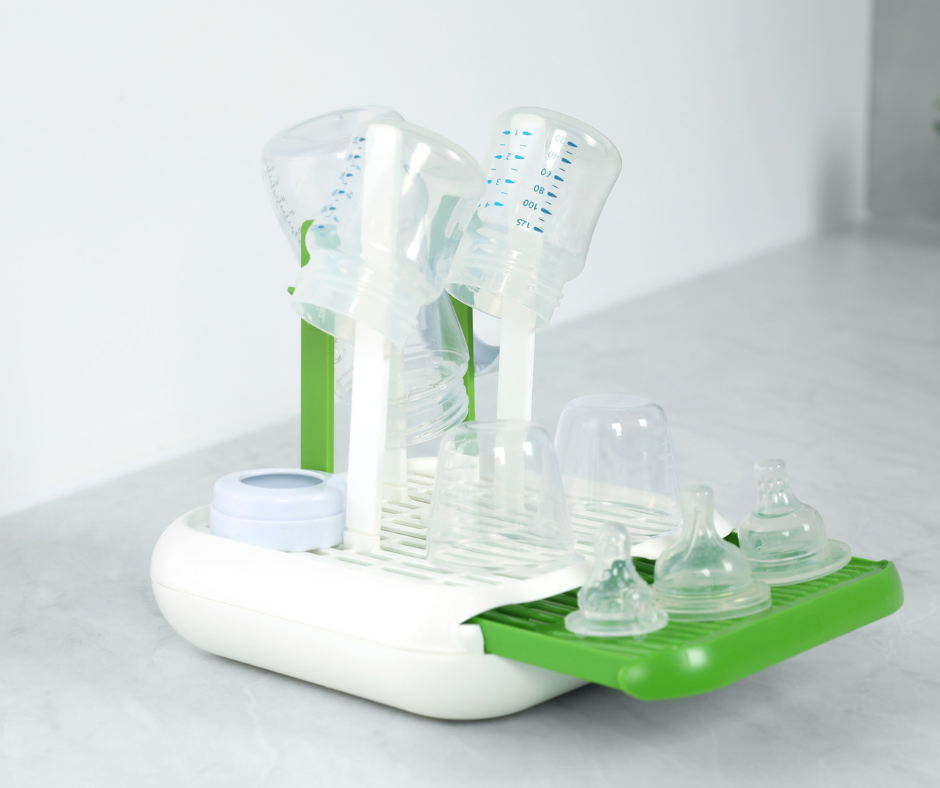
Why Air-Drying Is Important
After washing or sanitizing, feeding equipment should be allowed to air-dry thoroughly.
The CDC recommends placing items on a clean, unused dish towel or paper towel in an area protected from dirt and dust.
Avoid rubbing or patting bottle parts dry with a dish towel.
Even a towel that looks clean can transfer microorganisms.
Equipment should be completely dry before being assembled and stored.
Storing damp bottle parts in a closed container can trap moisture.
How Should Clean Bottles Be Stored?
Once all components are completely dry, they can be reassembled and stored in a clean, protected location.
A covered cabinet or other clean storage area is generally appropriate.
Avoid storing clean equipment directly beside dirty dishes, trash, or food preparation surfaces where contamination may occur.
An NCS should also avoid placing clean bottle nipples directly onto countertops that haven’t been cleaned.
The goal is to prevent recontamination after cleaning.
How Often Should Bottle Brushes Be Replaced?
There isn’t one universal replacement schedule for every bottle brush.
Replacement depends on the manufacturer’s instructions, the brush’s condition, and how it is used.
Inspect brushes regularly.
Replace them if the bristles become damaged, the brush is difficult to clean, or there are signs of deterioration.
The brush itself should be washed after use and allowed to dry.
A dedicated bottle brush should not be used to clean unrelated household items.
What About Breast Pump Parts?
Breast pump equipment requires careful cleaning because milk-contact surfaces can become contaminated.
The CDC recommends cleaning pump parts that come into contact with breast milk after every use.
The specific process depends on the pump and manufacturer’s instructions.
Some parts may be dishwasher-safe, while others require handwashing.
Certain pump components should never be submerged in water.
An NCS should follow the manufacturer’s directions and any medical instructions provided to the family.
It’s also important to distinguish between cleaning pump parts and cleaning the pump’s external surfaces.
Both may be necessary, but they involve different procedures.
Why the Refrigerator Doesn’t Make Dirty Equipment Safe
Cold temperatures slow the growth of many microorganisms, but refrigeration doesn’t reliably eliminate them.
Placing used bottle or pump parts in the refrigerator instead of cleaning them is not equivalent to washing.
The CDC recommends cleaning milk-contact pump parts after every use rather than relying on refrigeration between sessions.
The same principle applies to bottles.
Used feeding equipment should be properly cleaned rather than stored dirty for later reuse.
Can You Reuse a Bottle That Still Has Milk in It?
This is a separate issue from cleaning, but it is closely related to feeding safety.
Once a baby begins drinking from a bottle, microorganisms from the baby’s mouth can enter the milk.
For prepared infant formula, the CDC recommends using the formula within one hour from the start of feeding and discarding any remaining formula after that period.
For expressed breast milk, the CDC recommends using leftover milk within two hours after the baby finishes feeding.
These timelines differ, so caregivers must know what type of milk is in the bottle.
An NCS should never assume that a partially consumed bottle can be refrigerated and reused indefinitely.
What About Bottles Prepared in Advance?
Advance preparation can be helpful during overnight newborn care.
However, safe storage depends on whether the bottle contains formula or expressed breast milk.
Prepared infant formula that hasn’t been used should generally be refrigerated immediately if it won’t be fed within two hours of preparation, and used within 24 hours when refrigerated.
Freshly expressed breast milk has different storage recommendations.
The CDC generally advises up to four hours at room temperature and up to four days in the refrigerator for freshly expressed breast milk under recommended conditions.
These guidelines assume appropriate collection, handling, and storage.
Families with premature or medically vulnerable infants may receive stricter instructions.
Why Labeling Matters
In households where multiple bottles are prepared, labeling can prevent mistakes.
Depending on the family’s needs, labels may include:
- Date
- Time prepared or expressed
- Type of milk
- Baby’s name when caring for multiples
- Any individualized feeding instructions
For twins, this can be particularly important when the babies have different feeding plans.
A consistent labeling system helps caregivers avoid confusion during busy overnight shifts.
What Should an NCS Do if Equipment Looks Damaged?
Feeding equipment should be inspected regularly.
Cracked bottles, torn nipples, damaged seals, or deteriorating components may create hygiene or safety concerns.
An NCS should remove damaged equipment from use and notify the parents.
Do not attempt to repair a damaged nipple or modify bottle components.
Replacement parts should be compatible with the manufacturer’s system.
Creating an Efficient Bottle-Cleaning Station
A well-organized feeding area can improve both efficiency and hygiene.
Consider establishing designated areas for:
- Dirty feeding equipment
- Washing
- Drying
- Clean storage
- Bottle preparation
- Labeling and documentation
The exact arrangement will depend on the household.
The important principle is to keep clean and dirty equipment separated.
An efficient system should make the safest process the easiest process to follow.
Common Bottle-Cleaning Mistakes
Even experienced caregivers can develop habits that aren’t consistent with current recommendations.
Common mistakes include:
Rinsing without washing
A quick rinse may remove visible milk but does not replace thorough cleaning.
Washing directly in the sink
The CDC recommends a separate basin for handwashing infant feeding items.
Skipping small components
Valves, collars, and venting systems can retain milk residue.
Sanitizing without cleaning first
Sanitizing is an additional step, not a substitute for removing milk residue.
Drying with a used towel
Towels can transfer germs back onto clean equipment.
Storing damp bottles
Allowing equipment to dry completely helps prevent moisture from remaining trapped during storage.
Assuming all bottle materials tolerate boiling
Always follow manufacturer instructions.
Using the same brush for household dishes and baby bottles
Dedicated cleaning tools help reduce cross-contamination.
What Does the Research Say?
Public health guidance from the CDC emphasizes thorough cleaning after every feeding and additional sanitizing for infants at greater risk of infection.
The recommendations reflect the importance of preventing contamination of equipment that comes into contact with infant milk.
Research and outbreak investigations have also highlighted the vulnerability of young infants, particularly premature and medically fragile babies, to infections associated with contaminated feeding products or equipment.
For example, Cronobacter infections are rare but can be serious in young infants. These infections have been associated with contaminated powdered formula and feeding-related environments.
Proper cleaning and sanitizing are important preventive measures, although they cannot eliminate every possible risk.
Why Education Matters
Bottle cleaning may seem like one of the simplest parts of newborn care.
But the details matter.
A professional NCS should understand why equipment needs to be disassembled, why sanitizing isn’t the same as cleaning, why air-drying is recommended, and why the youngest infants may need additional precautions.
This knowledge helps caregivers establish safe routines and explain those routines to families.
It also reinforces an important professional principle: everyday newborn care practices should be based on current evidence rather than assumptions or outdated habits.
Interested in Learning More About Newborn Feeding Safety?
At Newborn Care Solutions®, our educational programs help Newborn Care Specialists, nannies, postpartum doulas, and other infant care professionals strengthen their understanding of newborn feeding, hygiene, safety, development, and professional practice.
From preparing and handling milk to recognizing feeding cues and maintaining safe care environments, professional education helps caregivers make informed decisions in families’ homes.
Whether you’re beginning your career or expanding your expertise, continuing education can help you provide more confident, evidence-based care.
Not sure which training path is right for you?
Take our free NCS Training Path Quiz:
References
- Centers for Disease Control and Prevention. How to Clean, Sanitize, and Store Infant Feeding Items.
- Centers for Disease Control and Prevention. How to Prepare and Store Powdered Infant Formula.
- Centers for Disease Control and Prevention. Breast Milk Storage and Preparation.
- Centers for Disease Control and Prevention. About Cronobacter Infection.
- American Academy of Pediatrics. HealthyChildren.org. Infant Feeding and Bottle Safety Resources.
Final Thoughts
Cleaning baby bottles isn’t complicated, but it does require attention to detail.
Every feeding creates another opportunity for milk residue and microorganisms to remain on equipment.
Thorough washing, appropriate sanitizing, complete drying, and clean storage all contribute to safer feeding practices.
For Newborn Care Specialists, these routines are part of the professional responsibility that comes with caring for vulnerable infants.
Families may not always see the work that goes into maintaining clean feeding equipment.
But they benefit from it every day.
Excellent newborn care is often built on small, consistent practices that protect a baby’s health long before a problem ever develops.