 Skip to content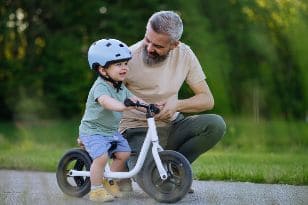
Have you ever seen a tiny child cruising around on a bike with no pedals and wondered what on earth is happening? In this episode, I’m talking about balance bikes, why they are fantastic, and why training wheels are officially on my list of parenting things I hate.
Training wheels may seem like the classic way to teach a kid to ride a bike, but I’m making the case for doing things differently. Balance bikes help kids build the skills that actually matter first, while training wheels can create habits that have to be unlearned later. And if you’re thinking, “But Devon, I learned on training wheels,” do not worry. I have thoughts about that too.
I’m breaking down what balance bikes are, how they work, why they can make bike riding feel more natural for kids, and what to consider if buying both a balance bike and a pedal bike feels like too much. This episode will help you rethink the classic training-wheels approach and see why a tiny bike with no pedals might be exactly what your kid needs.
Have you ever noticed a very small child riding a tiny bicycle that has no pedals and wondered what the heck is that all about? Stay tuned to learn all about balance bikes and why they’re amazing.
Welcome to Parenthood Prep, the only show that helps sleep-deprived parents and overwhelmed parents-to-be to successfully navigate those all-important early years with their baby, toddler, and child. If you are ready to provide the best care for your newborn, manage those toddler tantrums, and grow with your child, you’re in the right place. Now here’s your host, baby, and parenting expert, Devon Clement.
Hello, hello, and welcome back to the Parenthood Prep podcast, 101 episodes, which is crazy. When I decided to start a podcast, I never thought that I would get to this point because I’m not a person who is super great at consistency, and I’m pretty excited and proud that we’ve gotten this far. And we wouldn’t have gotten here if it wasn’t for having listeners, which we didn’t have in the beginning, and now we do. So it’s very exciting. And I just want to thank everyone who listens and recommends it to your friends and shares it and passes it along. I’ve sent it to some friends and family who have recently had babies. So hi, if that’s one of you. Congratulations again. Congratulations to all of you, if you have a baby or are having a baby or chose not to have a baby and just like the sound of my voice. I mean, whatever.
So here we are. I just got back from a summer vacation in Europe. We did a couple of different things. We went to Salzburg, Austria, where one of my favorite movies, The Sound of Music, was filmed, and I made poor Alex do a Sound of Music bicycle tour where we rode bikes all over the countryside visiting sites from the movie. Yes, including the gazebo. You can actually see that on my Instagram, Devon Clement_, as well as a fun video of me doing the I Have Confidence little run skip down the lane to the house. So that was really fun.
We also went to Slovenia, basically because it was right there, and we had heard great things about it, and they were absolutely true. It is a beautiful country. It is easy to navigate. The people are lovely. It’s a really wonderful place to visit. So I highly, highly recommend Slovenia. And it kind of has it all in like a tiny country.
We went to the mountains, we did a hike. We went to beautiful lakes. We went to the coastline and went to the beach. I call it the beach loosely because it was where the water met the land, but there wasn’t exactly like a sandy beach. If you’ve ever been to Croatia or that part of Italy, it’s like cement. So you sort of sit or lay on cement or rocks, but the water is amazing. I think it’s the Adriatic. Don’t quiz me on geography. It’s not my strong suit. But yes, anyway, that was all lovely.
And our tour of Salzburg on bicycles had me thinking about the topic that I want to talk about today, part of a new series I am going to call “Things I Hate.” There are a few things. Like I said, I have been doing this long enough that I am not really judging anyone for anything. We’re all just out here doing our best. But there’s a couple of things about parenting, babyhood, childhood that I’m like, can we do that differently? Especially if it’s something that’s been done a certain way for a really long time, like judging other people. Can we not do that? Can we stop that? That’s something I hate. We can talk about that in a future episode.
The thing today that we’re going to talk about that I hate is training wheels. Training wheels on a bicycle. And you’re like, “But Devon, I learned to ride with training wheels.” No, you didn’t. You didn’t. You rode a bike with training wheels, and then you learned how to ride a bike without them. Training wheels do not actually teach you anything.
In fact, all they really teach you is the wrong way to ride a bicycle, so that then when your training wheels come off and you need to be taught the proper way to balance on a bicycle, to lean into the turns, to brake, all those things, it’s going to be much harder for you to learn that. So I’m sure everyone remembers, everyone who knows how to ride a bike. I know several adults that don’t know how to ride bikes for some inexplicable reason, but here we are.
I also know several adults who have learned to ride a bike as an adult, which I just think, I’m so impressed by that. My friend Alessandra, hi, she listens to the podcast. When we first met, she was taking lessons in Central Park for how to ride a bicycle. And now she lives in Italy and she bikes everywhere. Riding a bicycle is a great tool, and I think it’s a pretty common—I wouldn’t say universal—but a pretty common childhood experience to learn how to ride a bicycle.
So, what is the alternative to training wheels? Do you just put your three-year-old on a full-size pedal bike and say go and that’s it? With you running behind them, holding onto the seat and them saying, “Don’t let go, don’t let go,” and you’re like, “I’m not going to let go,” but then you let go, and they start riding and they’re like, “I’m doing it!” I have also helped several children learn how to ride their bikes alongside their parents as their nanny or babysitter, and it’s a really wonderful experience.
But what’s even better is when a kid just learns how to ride a bike the natural way with a balance bike. Balance bikes are fantastic, and if you are not a parent or not somebody who works with kids, you may not even be aware that they exist. Have you ever seen a child, usually a pretty small child, like three, maybe even two and a half, two, four, riding a bike with no pedals? And you’re like, “What is that? How is that a bicycle with no pedals? What are they doing?” And what they’re actually doing is running along with their feet like Fred Flintstone, and then they start to get up speed, and they pick their feet up, and they’re just going because they’re balancing, because they’re learning to balance. They’re learning to turn, they’re learning to do all of those things before they learn how to pedal.
When you have a bike with training wheels, literally the only thing you’re learning how to do is push pedals, and you’re not learning how to balance, and you’re not learning how to do it while balancing. You’re not learning how to control your speed. You’re not really learning how to brake because training wheels kind of stop you pretty easily. You can’t go crazy, crazy fast or anything like that.
Not that we want kids going crazy, crazy fast. And please, for the love of God, put them in a helmet on any wheeled thing: a scooter, a bicycle, a balance bike, anything. Put them in a helmet. Please, please, please. I say this as being a bad helmet-wearer myself. I am trying to be better, but children, absolutely, helmets, helmets, helmets, helmets, helmets.
So, I was reading some articles in preparation for this podcast because I was like, well, I mean, I know that balance bikes are great. I know that they’re way better. Lots of physical therapists, occupational therapists, like people who understand children’s movement better than I do, highly recommend them. People are really getting away from training wheels. And so I started reading some articles, and the consensus is pretty much universal that balance bikes are a better way to learn. There was an article that I read on a USA Cycling website that was like, “Balance bikes and training wheels are both very valid ways to learn.” And I was like, “Let me see what your arguments are here.”
And basically their arguments were that because balance bikes are a lot smaller because kids have to be close to the ground to be able to stop with their feet, and that they don’t have pedals, that they don’t last as long, that you can only have a balance bike when you’re pretty small, and then you have to get a different bike when you’re ready for pedals. Versus, if you have training wheels, then you can take your normal bike with pedals, put training wheels on it, and then take the training wheels off and have the bike for longer. And that makes sense. I understand that. I don’t want people to think that their kid can’t learn to ride a bike because they can’t afford two bicycles for their child throughout their childhood. But I feel like that is not a reason to choose a worse way for your kid to learn how to ride a bike.
There’s Facebook Marketplace. There’s local buy-nothing groups. There are so many ways to get free or inexpensive child equipment because, you know what? The upside is of that balance bike not lasting very long. People in your town, people in your neighborhood, are probably trying to get rid of them. You could probably buy it for really cheap or even get it for free. Or you buy one and then you sell it when your kid is out of it, and you get some of that money back. You know, you can ask for it like a Christmas present or a birthday present from grandparents or family members or whatever. I don’t think that should be such a deterrent to learning how to ride.
So next time you’re at the park, walking your dog, pushing your baby in a stroller, look for kids on bikes and see if you spot kids on balance bikes and how great they are for learning how to ride a bike properly from the beginning instead of learning one way and then having to unlearn.
Oh, also, something I learned from reading about it is that with a balance bike, kids learn the right way to turn where you lean into the turn. And with training wheels, because the bike stays upright no matter what, they actually lean away from the turn. So then when you take the training wheels off, you have to completely relearn that, like flip it in your brain.
This is just a random thing, but what was I listening to? It was a long time ago. It was an audiobook or maybe a podcast about a guy who invented a backwards bicycle. Everything works the opposite. And it took him a long time. He knew how to ride a normal bike. He learned how to ride the backwards bike because your brain can’t do things opposite that it’s used to doing. But then when he learned to ride the backwards bike, he couldn’t ride a normal bike anymore. I just thought that was so interesting. It’s such an interesting thing that happens in your brain when you’re riding a bicycle.
So you have to learn to trust yourself. You have to learn to trust your balance. And you do that with a balance bike, and you do not do that with a training wheel bike. You learn to trust the training wheels.
Oh, you know what it made me think of? Trying to find an argument for training wheels in a way that they’re better than a balance bike reminded me of an article that was in the New York Times a few years ago when people started importing European formula for babies. There was an article in the New York Times about how people were doing this.
And at first, I think there was some skepticism, of course. You know, it’s a new thing. It’s from another country. Can we trust this? I mean, I’m going to tell you, people were like, “Well, it’s not FDA-approved.” I trust the FDA of Germany more than I trust the FDA here. Like if this is what parents are feeding their babies in European countries, which speaking of my European trip, if anyone’s ever been to Europe, you know the food quality is just so much better there. The food standards and regulations are so much higher. I mean, especially than us right now. People are getting explosive diarrhea from lettuce. Could we please just have some regulations? Can I have some regulations, please?
So anyway, I think that importing your formula from another country that has really good standards and practices is an absolutely valid choice. What this actually has done is trigger companies in the US to start making better quality formulas, which I’m thrilled about.
Anyway, there was this article in the New York Times when parents started importing European formulas, and they always want to start with a story of a real person who did this and what happened. And it was a story of something terrible that happened when people, when a couple started feeding their baby European formula. And it was meant to shock, you know. These people got European formula, and their baby got very sick and almost died. Because the people made it wrong. Yes, the instructions are in German. You need to figure out what the instructions say.
They were doing in a lot of the American formulas, one scoop of formula to two ounces of water. They were doing that, and a lot of the European formulas where the scoop is visibly much smaller are one scoop of formula to one ounce of water, which also gives you the ability to make odd-numbered ounce bottles, which is also really helpful.
But this whole article about how these people had this terrible experience with European formula was because they were making it wrong, because they were making one scoop to two ounces, which is half the concentration it’s supposed to be. Of course you’re going to have a terrible experience. So yes, make sure you’re translating the instructions and understanding how to make it correctly, but don’t blame the formula because you didn’t do that.
And so yeah, so I feel like the argument that balance bikes are like an extra bicycle to get your kid, so therefore they’re not, training wheels can be a really good way to learn, is just not that valid. It’s like saying, I don’t know, “I couldn’t afford formula at all, so I gave my kid just whole cow’s milk.” That is not a valid alternative. It is not. Your kid is going to get sick, they’re going to be undernourished. That is not valid.
So anyway, I’m not trying to rag on people who do not have financial privilege. I hope it does not come across that way. I’m just saying don’t make a worse, significantly worse choice because you don’t want to pay for a balance bike.
Anyway, balance bikes are great. You should get one for your kid. You should see kids in the wild riding them and how cool it is to see like a little three-year-old who can actually balance on a bicycle and coast and turn and do all those things that we learn how to do only when the training wheels come off.
To be sure you never miss an episode, be sure to follow the show in your favorite podcast app. We’d also love to connect with you on social media. You can find us on Instagram @happyfamilyafter or at our website HappyFamilyAfter.com. On our website you can also leave us a voicemail with any questions or thoughts you might have, and you can roast your baby. Talk to you soon.
Thanks for listening to this week’s episode of Parenthood Prep. If you want to learn more about the services Devon offers, as well as access her free monthly newborn care webinars, head on over to www.HappyFamilyAfter.com.