 Skip to content
Quick Answer
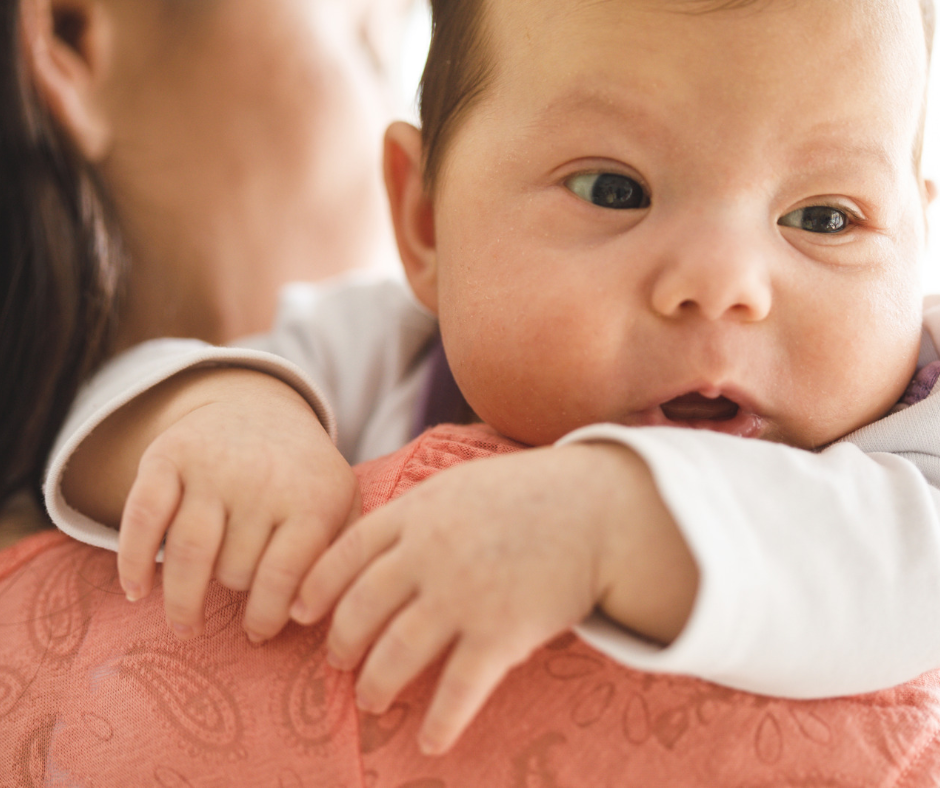
Newborns don’t maintain eye contact the way older children and adults do. During face-to-face interaction, a baby may briefly look toward a caregiver, turn their head away, close their eyes, or shift their gaze elsewhere.
This behavior, sometimes described as gaze aversion, can be part of normal early development. Young babies have limited abilities to sustain attention and manage incoming sensory information. Looking away may allow them to take a break from interaction or respond to changes in their environment.
However, not every instance of looking away means a baby is overstimulated. Newborn vision, alertness, fatigue, and normal variability also influence where babies look.
For Newborn Care Specialists, understanding these behaviors helps prevent misinterpretation and encourages responsive interaction that follows the baby’s cues rather than demanding continuous eye contact.
Key Takeaways
- Newborns have limited visual attention compared with older infants.
- Brief periods of looking away during interaction are common.
- Gaze aversion may be one way babies reduce or disengage from stimulation.
- Looking away doesn’t automatically mean a baby is upset or rejecting a caregiver.
- Eye contact develops gradually and varies with alertness and developmental stage.
- Newborns may be more visually attentive during quiet alert periods.
- Caregivers should avoid forcing eye contact or repeatedly repositioning a baby’s face.
- Looking away should be interpreted alongside other behavioral cues.
- Persistent concerns about visual responsiveness or development should be discussed with the pediatrician.
- Responsive caregiving involves allowing babies to engage and disengage at their own pace.
Newborns Are Learning How to Pay Attention
Adults can participate in a conversation, maintain eye contact, listen to background noise, and adjust their attention almost automatically.
Newborns cannot do all of those things in the same way.
Their visual systems and neurological mechanisms for attention are still developing.
Even a simple face-to-face interaction involves multiple sources of information.
A baby may be processing:
- A caregiver’s face
- The sound of a voice
- Changes in facial expression
- Movement
- Touch
- Light
- Background sounds
- Their own internal sensations
For a newborn, these experiences can require considerable attention.
Looking away may be part of how the baby shifts or disengages attention.
What Is Gaze Aversion?
Gaze aversion refers to directing the eyes away from a person, object, or other visual stimulus.
In newborns and young infants, this may occur during social interaction.
For example, a caregiver may lean close to a baby, smile, and begin talking.
The baby looks toward the caregiver briefly.
Then the baby turns their eyes or head away.
The caregiver may interpret this as a lack of interest.
But the baby may simply be shifting attention, responding to another stimulus, or taking a break.
Gaze aversion is a behavioral observation, not a diagnosis.
Its meaning depends on the broader context.
Why Do Newborns Look Away During Face-to-Face Interaction?
Several factors may contribute.
Developing attention
Newborns have limited capacity to sustain visual attention.
They may look toward a face briefly and then shift their gaze elsewhere.
This can be part of normal development.
Sensory stimulation
Face-to-face interaction can involve movement, sound, touch, and changing expressions.
A baby may look away when the amount of stimulation becomes difficult to manage.
Fatigue
A tired newborn may become less visually engaged.
They may look away, close their eyes, or show other signs of needing rest.
Changes in alertness
Newborns move through different behavioral states throughout the day.
A baby who is quietly alert may respond differently from one who is drowsy or crying.
Normal individual variation
Not every newborn responds to interaction in the same way.
Some babies may maintain visual attention slightly longer than others.
Individual differences don’t automatically indicate a developmental problem.
Does Looking Away Mean a Baby Is Overstimulated?
Not necessarily.
Gaze aversion can occur when a baby needs a break from stimulation, but looking away alone isn’t enough to conclude that the baby is overstimulated.
Other cues may provide additional information.
For example, a baby who looks away while remaining relaxed may simply be shifting attention.
A baby who looks away while becoming increasingly tense, fussy, or disorganized may be showing signs that the interaction is becoming too much.
An NCS should observe the whole baby rather than assign one meaning to a single behavior.
What Are Other Signs That a Newborn Needs a Break?
Possible signs that a baby is becoming tired or having difficulty managing stimulation include:
- Turning the head away
- Closing the eyes
- Increasing fussiness
- Changes in muscle tension
- Frantic or disorganized movements
- Difficulty maintaining a calm alert state
- Yawning
- Hiccups in some contexts
- Changes in facial expression
These behaviors are not specific diagnostic indicators of overstimulation.
For example, yawning may simply reflect tiredness, and hiccups are common in healthy newborns.
The important consideration is whether several changes occur together and how the baby responds when stimulation is reduced.
What Does a Baby Look Like When They’re Ready to Interact?
Newborns may show periods of quiet alertness during which they are more receptive to social interaction.
During these periods, a baby may:
- Keep their eyes open
- Look toward a caregiver’s face
- Remain relatively calm
- Show smooth or less frantic movements
- Respond to a familiar voice
- Maintain attention briefly
These periods can provide opportunities for gentle interaction.
However, newborns don’t need continuous stimulation to develop appropriately.
Ordinary caregiving interactions already provide many opportunities for sensory and social learning.
Newborn vision is still immature at birth.
Babies can detect faces and certain visual patterns, but their visual acuity and ability to sustain visual attention improve over time.
As the visual system develops, babies become better able to focus, track movement, and engage in longer periods of social looking.
This progression doesn’t happen at exactly the same rate for every infant.
Prematurity and other individual factors may also influence developmental timing.
An NCS should avoid comparing a newborn’s eye contact with that of an older baby.
How Close Should You Be When Interacting With a Newborn?
Newborns generally see best at relatively close distances.
A commonly cited range is approximately 8–12 inches, although visual performance depends on the task and conditions.
This is similar to the distance between a caregiver’s face and a baby during holding or feeding.
Gentle face-to-face interaction at a comfortable distance can provide an opportunity for visual engagement.
However, caregivers shouldn’t repeatedly move closer or insist on eye contact when a baby looks away.
The goal is to offer interaction, not demand a response.
What Should an NCS Do When a Baby Looks Away?
The simplest response is often to allow a pause.
If a newborn looks away during interaction, an NCS can:
- Reduce unnecessary movement
- Pause talking briefly
- Maintain a calm environment
- Allow the baby time to reorient
- Watch for additional cues
- Resume interaction if the baby appears interested
The caregiver doesn’t need to stop every interaction immediately after one glance away.
Instead, observe the baby’s overall state.
A relaxed baby may simply be looking around.
A baby who becomes increasingly fussy may benefit from less stimulation or a transition toward rest.
Adults sometimes try to regain a baby’s attention by moving their face directly into the baby’s line of sight.
They may repeatedly turn the baby’s head or increase their voice to encourage a response.
But this can create additional stimulation.
Newborns benefit from responsive interaction, not constant demands for engagement.
If a baby looks away, there is no need to treat it as a problem that must be corrected.
Allowing babies to disengage is part of respecting their developing capacity for attention.
A newborn who doesn’t appear interested in faces during a particular interaction may simply be sleepy, hungry, or in a less alert state.
However, persistent concerns about visual responsiveness should be discussed with the pediatrician.
Healthcare professionals consider the baby’s age, medical history, vision, neurological development, and overall behavior when evaluating concerns.
An NCS should not attempt to diagnose a developmental or visual disorder based on eye contact.
Similarly, an NCS should never tell parents that limited newborn eye contact is a sign of autism.
Autism cannot be diagnosed from a newborn’s gaze behavior alone.
How Does Gaze Aversion Relate to Self-Regulation?
Self-regulation refers broadly to the developing ability to manage physiological and behavioral states.
Newborns have limited independent regulatory abilities and depend heavily on caregivers for support.
Looking away may be one way a baby modulates exposure to visual and social stimulation.
However, it would be inaccurate to suggest that newborns deliberately use gaze aversion as a conscious coping strategy.
Rather, it is a behavioral response that may help limit incoming stimulation.
Over time, infants develop more sophisticated abilities to regulate attention and behavior.
Supporting Parent-Infant Interaction
Parents sometimes worry when their newborn doesn’t look directly at them.
They may wonder whether the baby recognizes them or enjoys being held.
An NCS can help explain that newborn interaction doesn’t look like adult interaction.
A baby doesn’t need to maintain eye contact to benefit from being held, spoken to, or cared for responsively.
The caregiver’s voice, touch, movement, and consistent responses all contribute to the baby’s experience.
Parents can be encouraged to enjoy brief moments of visual engagement without measuring the quality of their relationship by how long the baby looks at them.
What About Premature Babies?
Babies born prematurely may have different developmental needs and sensory tolerances.
Their responses to visual, auditory, and tactile stimulation can differ depending on gestational age, medical history, and individual development.
For infants recently discharged from the NICU, families should follow any individualized developmental care recommendations.
An NCS should be especially attentive to signs that the baby needs rest or reduced stimulation.
The goal is not to encourage more interaction than the baby can comfortably manage.
How Should an NCS Document Concerns About Visual Engagement?
Routine gaze aversion generally doesn’t require detailed documentation.
However, if parents or caregivers notice a persistent concern, objective observations may be useful.
For example:
“During two quiet alert periods, baby briefly looked toward caregiver’s face and then shifted gaze away. No distress observed.”
Or:
“Parents expressed concern that baby rarely appears to visually engage during awake periods. Recommended discussing observations with pediatrician.”
Avoid diagnostic conclusions such as:
“Baby has poor social development.”
That statement goes beyond what can be established through routine observation.
What Does the Research Say?
Research on infant attention and early social interaction has demonstrated that newborns can orient toward faces and certain face-like patterns.
Studies have also examined how infants shift attention during social interactions and how gaze behavior changes with development.
Infant gaze aversion has been discussed in relation to attention regulation and the management of social stimulation.
However, the meaning of gaze aversion varies with age, context, and other behavioral cues.
Research does not support interpreting every instance of looking away as overstimulation or emotional rejection.
For newborn care professionals, the evidence reinforces the value of observing patterns rather than assigning a fixed meaning to one behavior.
Why Education Matters
Newborn communication is subtle.
A baby cannot explain that they are tired, distracted, uncomfortable, or ready for a break.
Instead, caregivers must interpret combinations of behaviors.
Understanding gaze aversion helps an NCS avoid common mistakes, such as insisting on eye contact or assuming that a baby who looks away isn’t interested in their caregiver.
It also supports more realistic expectations for parents.
Professional newborn care education should help caregivers recognize normal developmental variability while understanding when persistent concerns deserve medical evaluation.
Interested in Learning More About Newborn Communication and Development?
Newborns communicate long before they can speak.
Their movements, facial expressions, alertness, feeding cues, and responses to stimulation provide valuable information about their needs.
At Newborn Care Solutions®, our educational programs help Newborn Care Specialists, nannies, postpartum doulas, and other infant care professionals strengthen their understanding of newborn development, behavior, feeding, sleep, and safety.
Whether you’re beginning your career or expanding your expertise, continuing education can help you interpret newborn behavior more accurately and support families with confidence.
Not sure which training path is right for you?
Take our free NCS Training Path Quiz:
References
- Johnson, M. H., Dziurawiec, S., Ellis, H., & Morton, J. (1991). Newborns’ preferential tracking of face-like stimuli and its subsequent decline. Cognition, 40(1–2), 1–19.
- Field, T. (1981). Infant gaze aversion and heart rate during face-to-face interactions. Infant Behavior and Development, 4, 307–315.
- Tronick, E. Z., Als, H., & Brazelton, T. B. (1977). Mutuality in mother-infant interaction. Journal of Communication, 27(2), 74–79.
- American Academy of Pediatrics. HealthyChildren.org. Infant Vision and Early Development Resources.
- Centers for Disease Control and Prevention. Developmental Milestones.
Final Thoughts
Newborns don’t communicate interest, fatigue, or the need for a break in the same way adults do.
A baby who looks away during interaction may simply be shifting attention, responding to stimulation, or moving into a different state of alertness.
That behavior doesn’t mean the baby dislikes the caregiver or isn’t benefiting from the interaction.
For Newborn Care Specialists, understanding gaze aversion is another reminder that newborn communication requires careful observation.
The goal isn’t to keep a baby’s attention at all costs.
It’s to recognize when the baby is available for interaction and when they may need a pause.
Sometimes one of the most responsive things a caregiver can do is allow a newborn to look away.